Probiotics for weight management: inside Flat Belly Tonic's 3-billion-CFU digestive blend

Updated August 2026 · reviewed by the Flat Belly Tonic Research Team. We are an independent information resource, not a medical provider, and this article is educational rather than medical advice.
Probiotics for weight management are live, beneficial bacteria taken to support everyday digestion and gut balance — not to treat weight itself — and in Flat Belly Tonic they arrive as a 3-billion-CFU culture paired with prebiotic inulin fiber that feeds them. That pairing is the whole idea behind the digestive blend: the fiber is the food, the culture is the friendly bacteria, and a comfortable gut makes healthy eating easier to keep.
What the 3-billion-CFU digestive blend actually is, in one place.
- What CFU means
- Colony-forming units — the count of live, viable bacteria delivered. 3 billion CFU is a modest, food-level daily dose.
- The prebiotic
- Inulin, a fiber from chicory root your body doesn’t digest — instead it feeds the friendly bacteria in your colon.
- Why they’re paired
- Prebiotic fiber is food for probiotics; paired, they are called a synbiotic.
- The honest limit
- Probiotics support digestion and gut comfort; they are not a weight-loss treatment, and the weight evidence is early.
Flat Belly Tonic is built from three blends — polyphenol, metabolic and digestive — and it is the last that pairs a probiotic culture with prebiotic fiber. Below we unpack what a colony-forming unit is, what inulin does, and where the honest limits of the evidence lie. For the full picture, read our Flat Belly Tonic review.

What are probiotics, and what does “3 billion CFU” mean?
Probiotics are live microorganisms that, taken in adequate amounts, are intended to support the friendly bacteria already living in your gut — the “good bacteria” you hear about in yoghurt and fermented foods. In a supplement they are measured not by weight but by how many are still alive, which is where CFU comes in.
What does CFU stand for?
CFU stands for colony-forming units, the standard way to count how many live, viable bacteria a probiotic delivers — a single unit being one bacterium able to grow into a visible colony. When a label says 3 billion CFU, each daily serving provides roughly three billion live organisms, a modest, food-level dose rather than a high therapeutic one.
Is a higher CFU count always better?
A bigger number on the label is not automatically a better product. The useful dose depends on the specific strains and your goal. For everyday gut balance, a modest dose paired with prebiotic fibre — so the bacteria have something to feed on — can be more sensible than a very high count alone. Extremely high, targeted doses are the territory of clinical use, not a daily wellness drink.
Two findings put a 3-billion-CFU dose in perspective. Pooled trials of probiotic supplementation in adults with overweight or obesity found small, strain-dependent reductions in body weight and fat percentage (Borgeraas H. et al. “Effects of probiotics on body weight, body mass index, fat mass and fat percentage in subjects with overweight or obesity: a systematic review and meta-analysis.” Obesity Reviews, 2018), and one of the most cited individual trials used a specific strain over twelve weeks to produce a modest reduction in abdominal fat area (Kadooka Y. et al. “Regulation of abdominal adiposity by probiotics (Lactobacillus gasseri SBT2055) in adults with obese tendencies in a randomized controlled trial.” European Journal of Clinical Nutrition, 2010). Neither result transfers automatically to a different strain or a different dose.
How does the digestive blend in Flat Belly Tonic work?
The digestive blend in Flat Belly Tonic works on a simple principle: pair the bacteria with their food. It combines a 3-billion-CFU probiotic culture with prebiotic inulin fiber, so each morning scoop delivers both the friendly organisms and the fibre that sustains them. A probiotic paired with its prebiotic like this is called a synbiotic.

What is inulin prebiotic fiber?
Inulin is a prebiotic fiber found naturally in chicory root, onions, garlic and asparagus. Unlike the starch in bread or rice, it is not broken down in the small intestine; it reaches the colon largely intact, where bacteria ferment it into short-chain fatty acids that nourish the gut lining. In short, a prebiotic is fibre that acts as food for your good bacteria.
How do prebiotics and probiotics work together?
Prebiotics and probiotics work together like seed and soil: the probiotic culture supplies friendly bacteria, and the prebiotic inulin gives them something to eat once they arrive. That is why Flat Belly Tonic places inulin and the culture in the same blend. The table below sums up the difference.
| Term | What it is | Role in Flat Belly Tonic |
|---|---|---|
| Probiotic | Live, beneficial bacteria (measured in CFU) | The 3-billion-CFU culture that supports everyday gut balance. |
| Prebiotic | Fibre that feeds beneficial bacteria | Inulin from chicory root — the food for the culture. |
| Synbiotic | A probiotic and prebiotic deliberately paired | The digestive blend as a whole — bacteria plus their fuel. |
| CFU | Colony-forming units — the count of live bacteria | Three billion per daily serving, a modest food-level dose. |
We unpack supporting gut health day to day on its own page, right down to fiber diversity, prebiotics and what live cultures can and cannot do.
Why does gut balance matter for a flatter-feeling middle?
Gut balance matters for a flatter-feeling middle because much of what we call “belly bloat” is really everyday digestion — gas, fluid and the pace at which food moves through you — rather than body fat. A gut fed with fibre and populated with friendly bacteria tends to feel more comfortable, which is what most people are really after. This is a comfort-and-digestion story, not a fat-loss claim.
There is a second, quieter reason: the fibre-rich foods that feed your gut bacteria also keep you full, so supporting digestion overlaps with supporting a healthy weight naturally — though the blend supports those habits rather than replacing them.

See the exact dose in Flat Belly Tonic
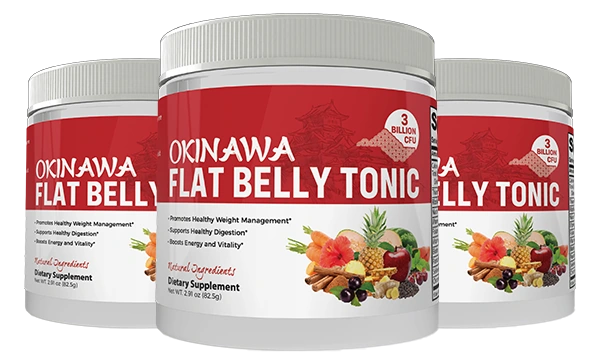
The digestive blend — prebiotic inulin fiber plus a 3-billion-CFU probiotic culture — is in every once-daily scoop. Because a probiotic routine builds gradually, most people choose a multi-month supply; the six-jar bundle is the best value at $49 per jar, with free U.S. shipping and a 90-day guarantee.
See the exact dose in Flat Belly Tonic — from $49/jarWhat is actually in Flat Belly Tonic’s digestive blend?
Flat Belly Tonic’s digestive blend is the third of its three sub-blends, alongside a polyphenol blend of antioxidant plants and a metabolic blend of culinary botanicals. The digestive portion is deliberately simple: fibre and a live culture, shown in context below.
| Blend | Key components | Intended everyday role |
|---|---|---|
| Polyphenol blend | Hibiscus, green tea, aronia berry, mulberry | Antioxidant plant compounds enjoyed as part of a wellness drink. |
| Metabolic blend | Cinnamon, ginger, turmeric, shilajit | Warming culinary botanicals long used in the kitchen. |
| Digestive blend | Inulin prebiotic fiber + 3-billion-CFU probiotic culture | Supports everyday gut balance and comfortable digestion. |
You can read the full label on the homepage’s ingredients section, and our companion article covers the antioxidant side: how hibiscus, green tea and probiotics fit metabolism.
How do you get the most from a probiotic routine?
The best probiotic routine is a consistent one, because a culture and its prebiotic fibre build their support gradually rather than overnight. Two practical points help:
When is the best time to take it?
Most people take Flat Belly Tonic once daily in the morning, one scoop mixed into water or a smoothie. The exact hour matters less than doing it at the same time each day — consistency is what lets a gradual routine accumulate.
What should you expect in the first days?
Because inulin is a fermentable fibre, some people notice temporary gas or a little bloating in the first few days as their gut adjusts — a normal part of adding fibre, not a sign anything is wrong. Staying hydrated and giving it a week or two usually smooths this out; if discomfort persists, check with your doctor.

What does the evidence actually say about probiotics and weight?
The honest summary is that evidence linking probiotics directly to weight change is still early, mixed and strain-specific. Some strains have shown small effects on body measures while others show little, and results rarely transfer from one product to another. No probiotic is a weight-loss treatment, and Flat Belly Tonic makes no such claim.
The clearer, better-supported role is digestive: probiotics and prebiotic fibre are widely used to support everyday gut comfort and regularity. That is the modest, realistic reason they sit in the blend — a supportive part of a routine, alongside the food, movement and sleep habits that do the real work.
Check today’s Flat Belly Tonic pricing →
When should you talk to a doctor?
Food-level probiotics and prebiotic fibre are well tolerated by most generally healthy adults, but a supplement is not a substitute for medical care. Speak with your doctor before starting if you are pregnant or nursing, under 18, immunocompromised, take any medication, or have a diagnosed digestive or metabolic condition — and if you notice persistent digestive symptoms, unexplained weight change or ongoing discomfort. A short conversation ensures the blend fits safely with your care.
This question overlaps with several others worth reading alongside it. There is a fuller treatment of ginger for digestion and bloating elsewhere on this site, covering the gastric-emptying evidence behind the root.
Frequently asked questions
What does 3 billion CFU mean in Flat Belly Tonic?
CFU stands for colony-forming units, the standard way to count live, viable bacteria in a probiotic. A 3-billion-CFU serving means each daily scoop provides roughly three billion live organisms — a modest, food-level dose to support everyday gut balance, not to treat any condition.
What is inulin prebiotic fiber and why is it in the blend?
Inulin is a prebiotic fiber from chicory root, onions and garlic. It is not digested in the small intestine; it reaches the colon where friendly bacteria ferment it. In Flat Belly Tonic, inulin acts as food for the probiotic culture, which is why the two are paired.
Do probiotics help with weight management?
Research on probiotics and body weight is still early and mixed, and no probiotic is a weight-loss treatment. The clearer role is supporting everyday digestion and gut comfort, which makes a fibre-rich way of eating easier to sustain. Flat Belly Tonic includes probiotics to support that routine, not to replace diet or activity.
Is a higher CFU count always better?
Not necessarily. More is not automatically better; the right dose depends on the strains and the goal. For everyday support, a modest dose paired with prebiotic fibre can be sensible. Very high therapeutic doses are a matter for a healthcare professional.
When is the best time to take the Flat Belly Tonic digestive blend?
Most people take Flat Belly Tonic once daily in the morning, one scoop in water or a smoothie. Consistency matters more than exact timing, because a probiotic and prebiotic routine builds its support gradually over days and weeks.
Are the probiotics in Flat Belly Tonic safe?
For most generally healthy adults, food-level probiotics and prebiotic fibre are well tolerated, though inulin can cause temporary gas or bloating as your gut adjusts. Flat Belly Tonic is a dietary supplement, not a drug. If you are pregnant, nursing, immunocompromised, take medication or have a diagnosed condition, ask your doctor first.
Try Flat Belly Tonic risk-free for 90 days →
Flat Belly Tonic is a dietary supplement, not a treatment for any medical condition. These statements have not been evaluated by the Food and Drug Administration. This product is not intended to diagnose, treat, cure or prevent any disease. Always consult a qualified healthcare professional about your individual needs.
References & further reading
- National Center for Complementary and Integrative Health (NCCIH). Probiotics: What You Need To Know. nccih.nih.gov/health/probiotics-what-you-need-to-know
- National Institutes of Health, Office of Dietary Supplements. Probiotics — Fact Sheet for Health Professionals. ods.od.nih.gov/factsheets/Probiotics-HealthProfessional
- Slavin J. “Fiber and prebiotics: mechanisms and health benefits.” Nutrients, 2013. pubmed.ncbi.nlm.nih.gov/23609775
- Borgeraas H. et al. “Effects of probiotics on body weight, body mass index, fat mass and fat percentage in subjects with overweight or obesity: a systematic review and meta-analysis.” Obesity Reviews, 2018. pubmed.ncbi.nlm.nih.gov/29047207
- Examine.com. Inulin — evidence-based summary. examine.com/supplements/inulin
- Harvard T.H. Chan School of Public Health. The Nutrition Source: Fiber. nutritionsource.hsph.harvard.edu/carbohydrates/fiber
These references describe the ingredients and habits in general terms and do not constitute evidence that any product treats, cures or prevents any condition.
Keep reading: how hibiscus, green tea and probiotics work · the best morning habits for a flatter belly · back to the Flat Belly Tonic blog · homepage.